
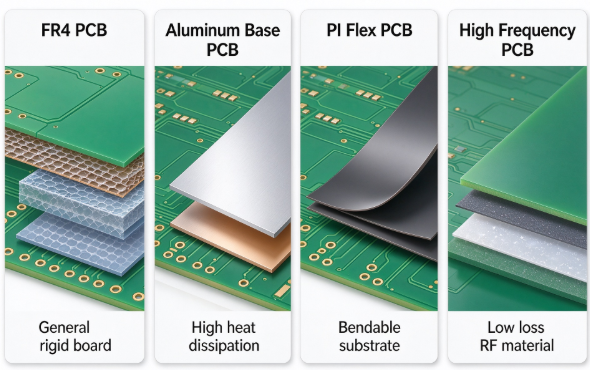
How to choose pcb base material is a critical question for every electronic project. Selecting the right PCB base material directly impacts product reliability, thermal dissipation, impedance stability and total manufacturing cost. Different substrates are designed for different application scenarios, so you need to match material properties with your project’s working environment and performance requirements.
- Applications: Consumer electronics, industrial control, power supply, general circuit boards
- Features: Flame retardant, stable dielectric property, low cost
- Applications: LED lighting, automotive power modules, power converters
- Features: Excellent thermal conductivity, fast heat dissipation, good dimensional stability
- Applications: Wearable devices, camera modules, flexible sensors, aerospace electronics
- Features: High heat resistance, lightweight, flexible, good dielectric stability
- Applications: Radar, 5G communication, microwave sensors, radio frequency modules
- Features: Low Df, stable Dk, low signal attenuation, suitable for high-speed & high-frequency circuits
- Applications: Smartphone, wearable electronics, high-density control modules
- Features: High wiring density, smaller form factor, controlled impedance
How to Select Your PCB Base Material
- Working frequency:Low frequency circuit → FR4; RF/microwave → high frequency substrate
- Heat dissipation requirement:High power → aluminum base PCB
- Bending requirement:Need flexing → PI flex material
- Operating temperature:High temperature environment → High TG FR4 or PI
- Cost budget:FR4 is the most cost-effective for general projects
Additional Tips for PCB Material Selection
Besides material types, you also need to consider working temperature, impedance requirement and manufacturing minimum thickness. High TG FR4 boards are suitable for high-temperature reflow soldering and industrial controllers. Aluminum substrate PCBs are preferred for LED lighting because of fast heat dissipation. For flexible electronics, polyimide(PI) can stand repeated bending. High-frequency laminates like Rogers are widely used in RF, antenna and microwave communication devices.
When you confirm your PCB substrate, send your Gerber files and requirements to our engineering team. We offer full PCB manufacturing and PCBA assembly service for worldwide customers.