
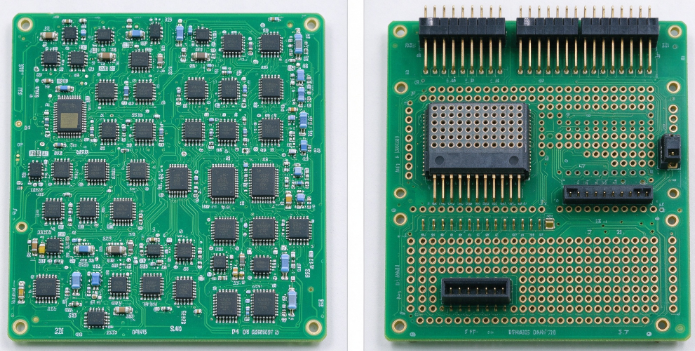
SMT vs DIP Assembly are the two mainstream PCB assembly technologies widely used in electronic manufacturing.
For electronic hardware designers and product developers, understanding SMT assembly and DIP assembly is essential before launching PCB fabrication. Both technologies attach electronic components to printed circuit boards, yet they feature distinct manufacturing workflows, component types, mechanical performance and suitable application scenarios. Choosing the wrong assembly method can lead to higher production cost, reliability failures or inability to fit your product enclosure.
It is common for new designers to underestimate the impact of assembly selection at the early design stage. A well-planned PCBA strategy can shorten your product development cycle and reduce unnecessary redesign work later. Many projects face delays simply because the selected assembly process cannot match the original PCB layout, forcing designers to modify board dimensions or component placement after prototyping. Early consultation with your PCB manufacturer helps you avoid these costly mistakes and optimize your design for manufacturability from the very beginning.
SMT assembly, short for Surface Mount Technology, mounts miniature surface-mount components directly onto the PCB surface. No through holes are mandatory for component leads. Automated pick-and-place machines rapidly and accurately place tiny resistors, capacitors and IC chips. This technology enables high-density PCB layouts, supporting compact, lightweight designs. SMT also offers stable high-frequency performance, ideal for miniaturized electronic modules. The automated production line greatly reduces human error and delivers consistent solder quality for large batch orders.
DIP assembly, also known as through-hole assembly, relies on components with long metal pins. These pins are inserted into pre-drilled holes on the PCB and soldered on the reverse side. DIP components are larger and physically sturdy. The through-hole solder joints form solid mechanical connections, providing outstanding resistance to vibration and physical impact. DIP parts are easier to manually replace or repair during prototype testing, which is a big advantage for R&D teams debugging circuit functions.
Key Differences
- Component Size & PCB Density SMT supports micro components and high-density layouts such as HDI PCBs. DIP components take up much more board space and restrict circuit integration density. If your product needs a slim and small form factor, SMT is almost always the preferred option.
- Production Efficiency & Unit Cost SMT assembly is fully automated. For mass production, it delivers fast turnaround and lower per-unit cost. DIP assembly often needs manual insertion for large parts, leading to higher unit prices for large batch orders. For small prototype runs, DIP may be more flexible without expensive setup for SMT stencils.
- Mechanical Durability DIP soldering creates robust mechanical bonds. It is the top choice for products exposed to continuous vibration or mechanical shock. SMT solder joints are smaller and less suitable for heavy physical stress, though modern SMT can still work well for normal indoor electronic devices.
- Typical Applications SMT assembly is widely used in consumer electronics, smart home devices and compact security control modules. DIP assembly fits power electronics, industrial controllers, high-current circuits and equipment requiring strong shock resistance.
Mixed assembly is a common practical solution. Manufacturers use SMT for most miniature chips and passive components, while applying DIP for heavy power connectors and large power parts. This hybrid approach balances compact layout and mechanical reliability. It is widely adopted in many industrial control products that combine dense logic circuits and high-current power interfaces.
Volectronics Tech Co., Ltd provides full-service PCB manufacturing & PCBA assembly. We produce rigid, flex, HDI and aluminum base PCB for industrial control, consumer electronics, smart home and security control systems. Our engineering team helps you evaluate SMT, DIP or mixed assembly according to your design specifications, performance targets and budget.
Whether you are working on prototype validation or mass production, our team will review your Gerber files and BOM list to recommend the most suitable assembly solution. We pay close attention to manufacturability, signal integrity and long-term stability of your PCBA.