
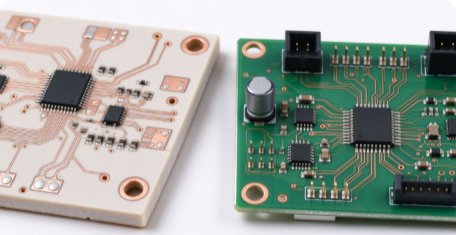
Aluminum Nitride (AlN) Ceramic Substrate vs aluminum mcpcb are two popular thermal circuit substrates for high-power devices. Both serve thermal management purposes but differ widely in thermal conductivity, insulation, cost and suitable applications. This guide compares their pros, cons and helps you select the right thermal PCB.
Thermal management is one of the biggest design challenges for high-power electronics. Many hardware engineers and procurement buyers are stuck choosing between Aluminum Nitride (AlN) ceramic substrate and standard Aluminum MCPCB (Metal Core PCB). Both are widely used thermal dissipation substrates, yet they are built on totally different structures, leading to huge gaps in thermal limit, temperature stability and long-term reliability. The core difference: Aluminum MCPCB relies on an organic dielectric layer for electrical insulation, while AlN ceramic itself serves as both insulator and heat conductor.
Quick summary: Go with aluminum MCPCB for low-to-medium power projects with tight budgets. Choose AlN ceramic substrate for high heat flux, high-temperature, RF, automotive and mission-critical high-reliability applications.
I. Structure Overview
🟩Aluminum MCPCB
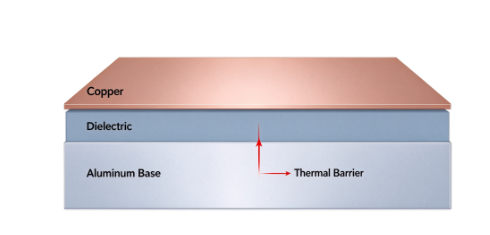
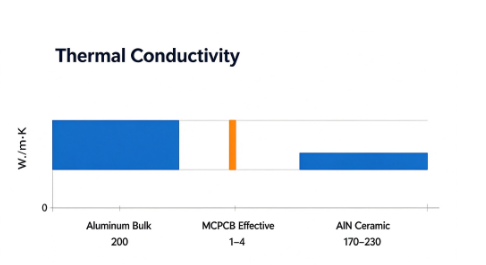
It adopts a three-layer stacked structure: copper circuit layer + organic dielectric layer + aluminum base. Pure aluminum has good thermal conductivity (~200 W/mK), but heat transfer is blocked by the middle adhesive dielectric. Its typical through-plane thermal conductivity is only 1–4 W/m·K, which becomes the main thermal bottleneck. To learn more about its applications and advantages in lighting products, read our dedicated guide: [LED MCPCB: Why Metal-Core PCBs Are Essential for LED Lighting]
🟩AlN Ceramic Substrate
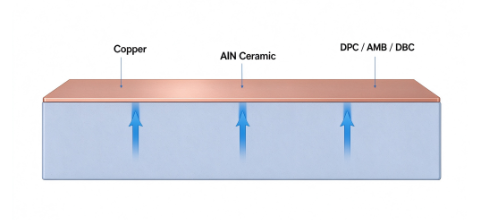
Copper is metallized directly on AlN ceramic via DPC, AMB or DBC technology, without any organic bonding layer that creates thermal resistance. The bulk thermal conductivity of AlN ceramic reaches 170–230 W/m·K. Since there is no low-conductivity dielectric adhesive, its through-plane thermal performance stays high and stable, making it ideal for high-power LED chips that require fast heat dissipation and tight junction temperature control.
II. Comparison Table
| Item | AlN Ceramic Substrate | Aluminum MCPCB |
| Through-plane thermal conductivity | 170–230 W/m·K | 1–4 W/m·K (limited by dielectric) |
| CTE | ~4.5 ppm/℃, well matched with silicon chips | ~23 ppm/℃, large mismatch with silicon |
| Continuous operating temperature | 250–350℃, stable performance | Max 130–150℃; dielectric ages quickly beyond this range |
| Dielectric loss | Low, ideal for RF & high-frequency circuits | High dielectric loss, not suitable for RF applications |
| Mechanical property | Hard and brittle, prone to cracking under strong impact | Tough, cuttable, drillable, good vibration resistance |
| Circuit capability | Fine traces, high-density interconnection | Limited trace precision, mostly single-layer design |
| Cost | High, about 3–8 times the price of aluminum MCPCB | Low, cost-effective for mass production |
| Allowable heat flux | >100 W/cm² | <10 W/cm² |
III. Pros & Cons
🟢Advantages of AlN Ceramic Substrate
- Ultra-high thermal conductivity to eliminate hot spots and control chip junction temperature
- CTE matches Si / GaN, reducing thermal stress during temperature cycling and improving long-term reliability for automotive and industrial products
- No organic resin; excellent resistance to high temperature and chemical corrosion
- Low dielectric loss for 5G RF amplifiers, radar and optical modules
- Stable insulation performance under high voltage
🟢Disadvantages of AlN Ceramic Substrate
- Higher raw material and processing cost
- Brittle material, not fit for scenarios with frequent shock or drop
- More complex manufacturing, relatively longer lead time
🟢Advantages of Aluminum MCPCB
- Low cost, fast lead time and mature global supply chain
- Good toughness, easy cutting, drilling and assembly; the aluminum base can act as a heat sink directly
- Simple design, widely accepted for standard lighting and power products
🟢Disadvantages of Aluminum MCPCB
- Thermal bottleneck from the dielectric layer; overheating easily occurs under high power density
- Organic dielectric degrades at high temperature, bringing risks of insulation drop and delamination
- CTE mismatch may cause solder joint failure after repeated thermal cycles
- Poor high-frequency performance
IV. Application Guide
✅Choose Aluminum MCPCB if you work on: General LED lighting, LED strips, panel lights, low-power consumer electronics, low heat flux, cost-sensitive mass production. Thermal management directly decides LED brightness stability and service life; check our practical design guidelines for LED circuits: [LED PCB Design: Key Factors for Brightness, Heat and Lifespan]
✅ Choose AlN Ceramic Substrate if you work on: High-power COB LED, UV LED, laser diodes, SiC/GaN power modules, automotive power electronics, RF power amplifiers, radar, compact high heat flux devices, projects requiring AEC-Q grade reliability. Its superior thermal performance suppresses junction temperature rise and prevents premature lumen depreciation under continuous heavy-load operation.
V. Common Misconceptions
Myth 1: Aluminum conducts heat better than AlN, so aluminum MCPCB cools better. Fact: Bulk aluminum has high thermal conductivity, but the adhesive dielectric blocks vertical heat flow. AlN has no such barrier and achieves much lower thermal resistance.
Myth 2: AlN substrate is always better than aluminum MCPCB. Fact: Using AlN for low-power projects is over-engineering and wastes budget. Aluminum MCPCB meets the requirements for most ordinary lighting and drivers.
Myth 3: Aluminum MCPCB can run continuously at 200℃. Fact: The organic dielectric layer ages rapidly above 130℃, and insulation performance will decline sharply.
VI. CTA
Still unsure which substrate suits your project? Send us your power density, board dimension, working temperature and end application. Our engineering team will provide free technical suggestions and quotation.
We support fast prototyping for DPC / AMB AlN ceramic boards and aluminum MCPCB.