
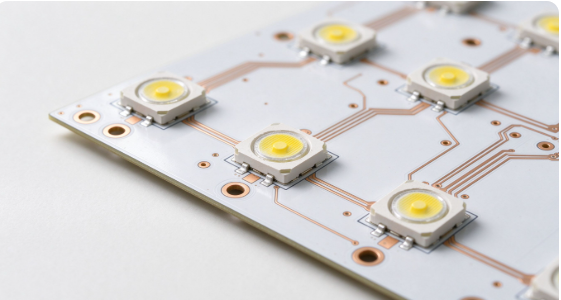
An LED MCPCB uses a metal core to draw heat away and keep the light stable.LEDs get hot. Really hot. And heat is the fastest way to shorten an LED’s life and dim its light. That is why so many LED designs use a metal-core PCB (MCPCB) — a board built on an aluminum or copper base that pulls heat away from the LED so it stays bright and lasts longer.
This guide explains what an MCPCB is, why it matters for LED lighting, and how to choose the right one for your application.
What Is an MCPCB?
An MCPCB (metal-core printed circuit board), also called an aluminum PCB or metal-backed PCB, is a PCB whose base layer is metal — usually aluminum — instead of the fiberglass used in standard FR-4 boards.
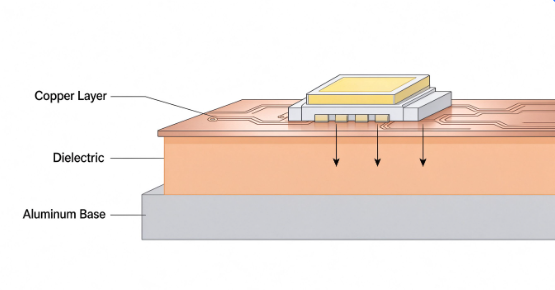
A typical MCPCB stackup has three layers:
- Circuit layer (copper)— where the traces and LED pads are etched
- Dielectric layer (thermal insulation)— a thin, thermally conductive insulator
- Metal base layer (aluminum or copper)— the heat-spreading core
The metal base conducts heat away from the LED efficiently, which is the entire point of using an MCPCB.
Why LED Lighting Needs an MCPCB
Standard FR-4 conducts heat poorly. When an LED runs on FR-4, heat builds up around the junction, raising the operating temperature. High temperature causes:
- Reduced light output
- Shorter LED lifespan
- Color shift over time
- Higher failure rates
An MCPCB solves this by giving heat a fast path out of the board. The metal core spreads and dissipates heat, keeping the LED junction cooler and the light stable.
Aluminum vs. Copper Core
Most MCPCBs use an aluminum base, but copper-core boards exist for the most demanding thermal loads.
| Core material | Thermal conductivity | Cost | Typical use |
| Aluminum | Good | Low–medium | Most LED lighting: strips, bulbs, panels, automotive |
| Copper | Excellent | High | High-power LEDs, high-current drivers, heat-critical designs |
Aluminum is the default for most LED applications because it balances thermal performance with cost. Copper is reserved for designs where heat is extreme.
Key Considerations When Choosing an MCPCB
When you spec an LED MCPCB, these factors matter most:
- Thermal conductivity of the dielectric.The insulating layer transfers heat to the metal core. Higher thermal conductivity means better heat spreading.
- Copper thickness.Thicker copper carries more current and spreads heat better, but costs more.
- Board thickness and core thickness.The metal core thickness affects heat capacity and mechanical strength.
- LED footprint and pad design.The pad size and layout under the LED affect how well heat transfers into the board.
- Surface finish.The finish on the LED pads affects solderability and long-term reliability.
MCPCB vs. FR-4 for LEDs
| Property | MCPCB (metal core) | FR-4 |
| Heat dissipation | Excellent | Poor |
| LED lifespan | Longer | Shorter |
| Cost | Higher | Lower |
| Best for | High-power LEDs, thermal-heavy designs | Low-power, simple indicator LEDs |
For most modern LED products — especially high-power and high-density lighting — the metal-core board is the right choice, even with its higher cost.
Applications of LED MCPCBs
MCPCBs are used wherever LEDs produce meaningful heat:
- LED strip and linear lights
- LED bulbs and modules
- Automotive LED headlights and signal lights
- LED panel and display backlighting
- Street and architectural lighting
- High-brightness industrial lighting
Get Your LED MCPCB Right
Choosing the right MCPCB — core material, copper thickness, thermal dielectric, and pad design — directly determines how well your LED product performs and how long it lasts.
At Volectronics Tech Co., Ltd, we produce aluminum and copper-core MCPCBs for LED lighting, with the stackup and thermal design reviewed before production so your LEDs stay cool, bright, and reliable.