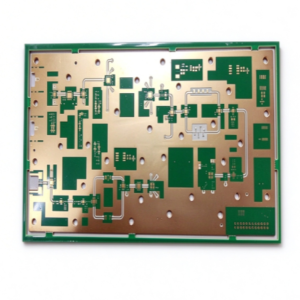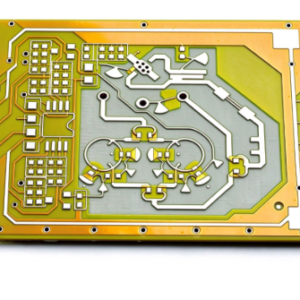
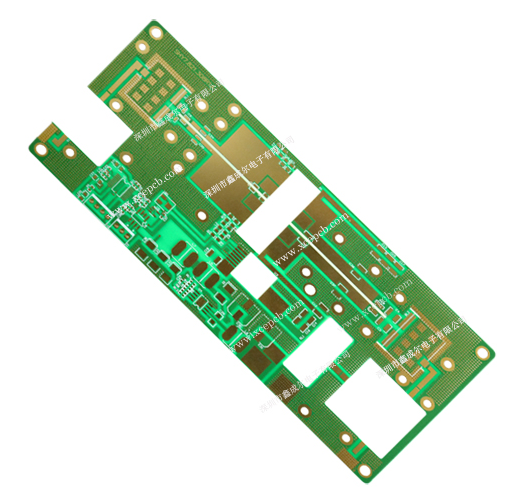
This High Frequency RF Microwave PCB is purpose-engineered for antennas, radar systems, 5G millimeter-wave equipment, and RF front-end modules, where signal integrity, low loss, and dimensional stability are essential. Manufactured on premium Rogers high-frequency laminates — including RO4350B, RO4003C, and RT-series materials — each High Frequency RF Microwave PCB delivers a stable dielectric constant (Dk 2.2–3.48 ±0.05) and a low dissipation factor (Df 0.0009–0.0037), ensuring clean, low-attenuation transmission of radio frequency and microwave signals across the entire operating band.
Integrated Antenna Design
One of the standout features of this high-frequency PCB is the direct integration of antenna traces onto the board surface. Instead of relying on separate external antenna components, we fabricate 50Ω microstrip, stripline, or coplanar waveguide structures directly into the copper layer. This integration reduces assembly complexity, shortens signal paths, and improves impedance matching — resulting in stable antenna gain, low return loss, and reliable phase consistency across the operating band.
Precision Electrical Performance
The board is manufactured with strict impedance control of 50Ω (±5%), ensuring accurate matching between the antenna and the feeding network. Low-profile HVLP (hyper-very-low-profile) copper foil is available to minimize conductor roughness losses, which is especially important at millimeter-wave frequencies above 10 GHz. Controlled fiberglass weave effects, achieved through open-weave or uniform lamination techniques, further stabilize the dielectric constant and phase across the board, making these PCBs suitable for phased-array antennas and beamforming systems.
Wide Frequency Coverage
Depending on the selected Rogers material, these boards operate from DC up to 40 GHz, covering a broad range of applications including sub-6 GHz 5G base stations, C-band and Ku-band satellite communication, X-band radar, and Ka-band millimeter-wave systems. The combination of low dielectric loss and low water absorption (≤0.06%) keeps electrical performance stable even in humid or harsh operating environments.
Hybrid Lamination Option
To balance performance and cost, we offer hybrid lamination that combines Rogers high-frequency layers for the critical RF circuitry with standard FR4 inner layers for power distribution and control signals. This approach preserves radio-frequency performance where it matters while significantly reducing the overall material cost for multi-layer designs. Hybrid boards are available in 2 to 12 layers, providing design flexibility for complex RF modules.
Manufacturing Quality
Every board is produced with precise etching tolerances for antenna traces, tight impedance verification, and comprehensive quality control including impedance testing, AOI inspection, and dimensional checks. The surface finish — ENIG, immersion tin, or OSP — ensures excellent solderability, flat coplanarity, and long shelf life for fine-pitch components and BGA assembly. Boards are rated UL 94V-0 and halogen-free, meeting international safety and environmental standards.
Key Specifications
- Material: Rogers RO4350B / RO4003C / RT-series
- Dielectric Constant (Dk): 2.2–3.48 ±0.05
- Dissipation Factor (Df): 0.0009–0.0037
- Frequency Range: DC ~ 40 GHz
- Layers: 2–12 (Hybrid with FR4 available)
- Antenna Traces: Integrated, 50Ω controlled
- Impedance Control: 50Ω, ±5%
- Min Trace/Space: 4/4–3/3 mil
- Surface Finish: ENIG / Immersion Tin / OSP
- Operating Temp.: −55 ~ +150°C
- Flame Rating: UL 94V-0
Typical Applications
- Communication antennas and base stations
- Radar systems and 5G millimeter-wave equipment
- Satellite communication and microwave links
- RF front-end modules and power amplifiers
- Phased-array antennas and beamforming systems
Volectronics combines years of high-frequency PCB manufacturing experience with rigorous quality control to deliver Rogers boards that meet the most demanding RF and microwave requirements. Contact us for a custom quote on your antenna or high-frequency board design.