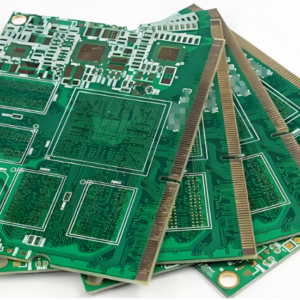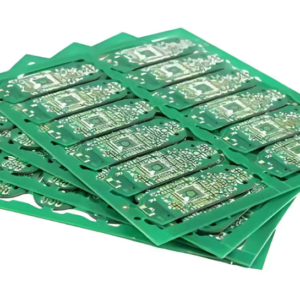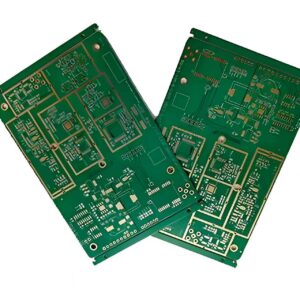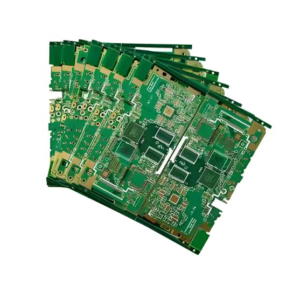
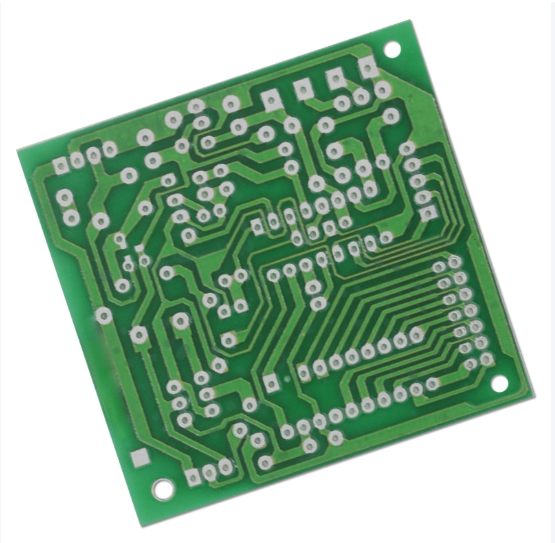
FR4 1.6mm UL94 V-0 Rigid PCB is our standard rigid printed circuit board, available in single-sided, double-sided and multilayer versions. This FR4 E-glass epoxy laminate PCB features UL94 V-0 flame retardant property with finished thickness 1.6 mm, widely used for power supplies, home appliances and industrial control electronics.
1. Specifications
- Base Material: FR-4 E-glass epoxy laminate, UL94 V-0 certified
- Layer Count: Single-sided (1L) / Double-sided (2L) / Multilayer (4–12L, up to 20L optional)
- Finished Board Thickness: 1.6mm ±0.1mm
- Copper Weight: 0.5oz (18μm) / 1oz (35μm, standard) / 2oz (70μm) / 3oz (105μm)
- Tg Option: Standard Tg 130–140°C; Mid Tg 150°C; High Tg 170°C
- Dielectric Constant (Dk): 4.2–4.7 @ 1MHz
- Dissipation Factor (Df): 0.014–0.025 @ 1MHz
- Minimum Trace / Space: 0.1mm (4mil)
- Minimum PTH Drill Size: 0.2mm
- Surface Finish: HASL-LF, ENIG, OSP, Immersion Silver, Immersion Tin
- Outline Tolerance: ±0.1mm
- Hole Position Tolerance: ±0.05mm
- Bow & Twist: ≤0.75% (SMT grade)
- Compliance: RoHS 2.0, REACH, IPC-6012, UL
- Electrical Test: 100% Flying Probe / Fixture Test + AOI inspection
2. Performance Characteristics
- Flame Retardancy: UL94 V-0. The board self-extinguishes within 10 seconds after removing the flame, no dripping particles that can ignite cotton. It meets safety requirements for power, industrial and home appliances.
- Electrical Insulation: Stable insulation property, high volume resistivity and dielectric strength. Good CTI performance for low voltage analog and mixed-signal circuits. Controlled impedance available for normal digital signals. Not suitable for mmWave and high-frequency RF applications.
- Mechanical Property: Reinforced by fiberglass, excellent rigidity and bending strength. 1.6mm thickness reduces warpage during SMT assembly and supports through-hole components well. Low water absorption (<0.1%), stable performance under changing temperature and humidity.
- Thermal Performance: Standard Tg version can withstand short-time lead-free reflow up to 260°C. High-Tg material provides better resistance against delamination and board burst for multiple reflow cycles and high-temperature industrial environments. Td ≥340°C.
- Dimensional Stability: Controlled CTE. Mature lamination process for multilayer boards with consistent mass production quality.
Layer difference brief: Single-layer PCB: Copper only on one side, no cross routing, simple circuits, lowest cost. Double-layer PCB: Copper on both sides connected by PTH vias, doubled routing space, most popular type. Multilayer PCB: Inner power and ground planes for lower EMI and cleaner signals, high wiring density for complex and high-speed circuits.
3. Solder Mask Properties
- Solder Mask Type: LPI (Liquid Photoimageable Solder Mask)
- Standard Color: Green; Optional: Black, White, Blue, Red, Matte Black
- Dry Mask Thickness: 10–25μm
- Feature: Clear pad opening, anti-soldering and no oil bleeding. Hardness ≥6H. Resistant to flux, cleaning solvent and reflow heat. Not easy to peel, wrinkle or form pinholes.
- Protection Function: Isolate copper traces to avoid short circuit, oxidation and scratch, reduce leakage risk.
- Adhesion: Strong bonding with FR4 substrate and copper surface, stable after multiple SMT thermal cycles.
- Legend Ink: White silkscreen for clear marking, convenient for assembly, testing and maintenance.
Note: White solder mask requires stricter pretreatment and exposure control, slightly lower yield and higher price than green mask.
4. Manufacturing Advantages
- Mature Global Supply Chain: FR4 is the most widely used substrate. 1.6mm core material is always in stock. Fast turnaround for single and double layer prototypes. Standardized lamination process for multilayer boards with high yield.
- Full Process Compatibility: Support drilling, PTH, copper plating, etching, solder mask, silkscreen, surface treatment, V-Cut, routing, impedance control, blind & buried vias.
- Flexible Cost Range: Single layer at the lowest cost; double layer with best cost-performance; multilayer built on demand. Much cheaper than aluminum substrate, ceramic substrate and PTFE high-frequency board.
- Great Assembly Compatibility: Compatible with through-hole assembly, SMT, wave soldering and reflow soldering. All common surface finishes are available. No special requirements for downstream PCBA factories.
- High Customization: Optional heavy copper for high current, impedance control, different Tg grades, halogen-free version and UL file matching.
Limitation: Low thermal conductivity (approx. 0.3–0.4 W/mK). Not ideal for high-power heat dissipation compared with MCPCB. Higher loss at high frequency than RF materials.
5. Application Scenarios
- Single-layer FR4 1.6mm UL94 V-0 PCB
Simple power boards, remote controllers, small home appliance control boards, toy PCBs, adapter secondary boards, basic LED driver boards, teaching demo boards, low-cost controllers.
- Double-layer FR4 1.6mm UL94 V-0 PCB (Best Seller)
SMPS power supplies, LED drivers, smart home modules, sensor boards, industrial data acquisition boards, security camera mainboards, audio amplifiers, electricity meters, HMI keypad boards, gateway peripheral boards and most consumer electronic control boards.
Multi-layer FR4 1.6mm UL94 V-0 PCB
Industrial main control boards, PLC interface boards, inverter control boards, router and switch mainboards, BGA boards, high-speed digital boards, BMS battery management boards, non-implantable medical control boards and test & measurement instrument boards.
Not Recommended For
High-power LED thermal solution (choose MCPCB), mmWave radio frequency (choose Rogers), flexible bending application (choose FPC).